By Ronald Robinson | Certified Google Partner | Former Google Strategist Category: Local SEO | Google Business Profile Read time: 9 minutes
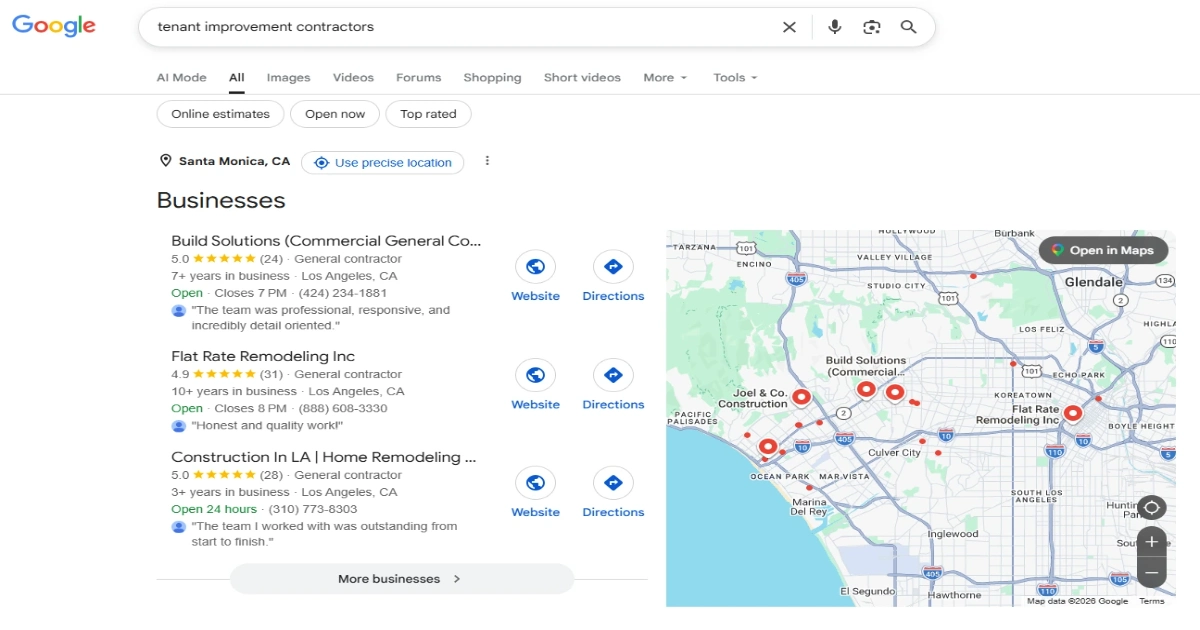
If you have ever searched for a service near you on Google and noticed a box showing three local businesses with a map, star ratings, phone numbers, and directions links at the top of the page, that is the Google Map Pack. And for local businesses across Los Angeles and Southern California, showing up in that box is one of the most valuable things you can do for your growth.
In this guide, I am going to break down exactly what the Google Map Pack is, why it matters more than ever in 2026, what Google looks at when deciding which businesses to show, and what you need to do right now to get your business into those top three spots.
I have spent nine years working directly at Google and the past several years managing local SEO campaigns for businesses across Greater Los Angeles. What I am sharing here is not generic advice. It is the same framework I apply for clients in Malibu, Beverly Hills, Santa Monica, Pasadena, and dozens of other cities across SoCal every single day.
What Is the Google Map Pack?
The Google Map Pack, also called the Local Pack or the 3-Pack, is the block of three local business listings that appears at the top of Google search results when someone searches for a product or service with local intent. You see it when someone types searches like “contractor near me,” “insurance agency Los Angeles,” or “carpet cleaning Pasadena.”
Each listing in the Map Pack shows:
- Business name
- Star rating and number of reviews
- Business category
- Address and distance from the searcher
- Phone number
- Hours of operation
- A link to directions
- Sometimes photos or a direct booking button
The Map Pack appears above the regular organic search results, which means it gets seen first. Studies consistently show that the top three Map Pack listings capture between 44% and 61% of all clicks on the page, including paid ads.
If your business is not in the Map Pack, you are invisible to the majority of people searching for exactly what you offer.
Why the Google Map Pack Matters More Than Ever in 2026
The way people search has changed dramatically over the past few years. Mobile searches with the phrase “near me” have grown by over 500% in the last five years. More than 76% of people who search for something nearby on their phone visit a business within 24 hours. And more than 28% of those visits result in a purchase.
Here in Los Angeles, that behavior is even more pronounced. With the density of competition in neighborhoods like West Hollywood, Culver City, Silver Lake, and Hollywood, the businesses that show up in the Map Pack own a significant share of local attention. Those that do not are fighting for whatever traffic is left over.
There is also a trust signal built into the Map Pack that organic results simply cannot replicate. When Google places your business in the top three local listings, it is effectively endorsing you as one of the most relevant and credible options in that area. Customers recognize this instinctively. They trust those three listings more than any paid ad or organic result below them.
In 2026, with AI-powered search features like Google’s AI Overviews pulling from Map Pack data and GBP information, being in the Map Pack now also influences whether your business gets cited by AI search tools. The Map Pack is no longer just a local SEO signal. It is a gateway to AI visibility too.
How Google Decides Who Gets Into the Map Pack
Google officially confirms these three factors in their Business Profile Help documentation.
Google uses three primary factors to determine which businesses appear in the Map Pack. Understanding these is the foundation of any effective local SEO strategy.
1. Relevance
Relevance is how well your Google Business Profile and website match what the searcher is looking for. If someone in Burbank searches for “commercial contractor,” Google needs to understand that your business is a commercial contractor, that you serve Burbank, and that the services you describe match what that person needs.
This is why your GBP category selection, business description, services section, and website content all need to be tightly aligned. Vague descriptions and generic categories hurt relevance. Specific, keyword-rich content built around the actual language your customers use when searching is what earns it.
2. Distance
Distance is how close your business is to the searcher’s location or to the location mentioned in the search query. A searcher in Glendale searching for “SEO agency” will see different results than a searcher in Torrance using the exact same phrase.
This is why businesses that serve multiple cities across the Los Angeles metro need dedicated location landing pages on their website and a well-optimized GBP service area. Google needs to understand not just where your office is, but which specific cities and neighborhoods you actively serve.
3. Prominence
Prominence is how well-known and trusted your business is, both online and offline. This is where most local businesses either win or fall behind. Prominence is built through:
- The number and quality of Google reviews
- Consistency of your business name, address, and phone number (NAP) across the web
- The strength and authority of your website
- The number of high-quality backlinks pointing to your site
- Your activity level on your Google Business Profile, including posts, photos, and Q&A responses
- Citations from trusted directories like Yelp, BBB, and local chamber of commerce listings
For businesses in competitive markets like Beverly Hills, Santa Monica, and Pasadena, prominence is often the deciding factor between showing up in the Map Pack and being pushed to page two.
The Role of Your Google Business Profile
Your Google Business Profile is the single most important asset for Map Pack rankings. It is the source of truth Google uses to build your listing. An incomplete, unoptimized, or neglected GBP profile is the number one reason local businesses fail to appear in the Map Pack despite having a good website and real customer reviews.
Here is what a fully optimized GBP looks like:
Business Name: Use your exact legal or trade name. Do not stuff keywords into the business name field. Google treats this as spam and it can get your listing suspended.
Category: Your primary category should be as specific as possible. If you are a carpet cleaning company, your primary category should be “Carpet Cleaning Service,” not just “Cleaning Service.” Add secondary categories for related services.
Description: Write a 750-character description that naturally includes your primary service keywords and the cities you serve. This is indexed by Google and contributes to relevance.
Services: Fill out every service you offer in the Services section. Each service can have its own name, description, and price range. This is often completely ignored by businesses and their competitors, which means doing it well gives you an immediate edge.
Photos: Google’s own data shows that businesses with more than 100 photos get 520% more calls and 2,717% more direction requests than businesses with fewer than 10 photos. Upload photos of your team, your work, your location, and your results. Use geo-tagged images where possible.
Posts: Publish a new GBP post at least once per week. Google treats post activity as a freshness signal. Businesses that post consistently rank higher than those that do not.
Reviews: Actively and consistently request reviews from every satisfied customer. Respond to every review, positive or negative. Review velocity, meaning how frequently you receive new reviews, matters as much as the overall star rating.
Q&A: Seed your own Q&A section with the most common questions your customers ask. Answer them thoroughly. This content is indexed by Google and contributes to relevance.
NAP Consistency: The Hidden Ranking Factor Most Businesses Get Wrong
NAP stands for Name, Address, and Phone number. It refers to how your business information appears across the web, on your website, in your GBP listing, on Yelp, on BBB, in local directories, and anywhere else your business is mentioned online.
Google cross-references all of these sources. When your NAP is consistent across every platform, it sends a strong trust signal that your business is legitimate, established, and accurately represented. When there are inconsistencies, Google’s confidence in your listing drops, and so do your rankings.
The most common NAP errors I see when auditing businesses in Los Angeles include:
- Using “Ave” on one listing and “Avenue” on another
- Listing a suite number on some platforms but not others
- Using a tracking phone number on the website that differs from the GBP number
- Having an old address from a previous location still showing on directories
- Using a slightly different version of the business name on different platforms
Every one of these inconsistencies is a small signal telling Google that something is off. The fix is straightforward: audit every directory and citation source, standardize your NAP format across all of them, and keep it consistent going forward.
For businesses in cities like Long Beach, Torrance, Sherman Oaks, Van Nuys, and Studio City, where there are often multiple competitors with similar names and overlapping service areas, NAP consistency can be the tiebreaker that puts you in the Map Pack and keeps your competitor out.
Local Landing Pages and the Map Pack
Your website is the foundation that supports your GBP. Google looks at your site to verify your relevance, confirm your service areas, and assess the authority of your business.
One of the most underused tactics for Map Pack visibility is building dedicated location landing pages for each city or neighborhood you serve. Instead of having one generic “Service Areas” page that lists 20 cities, you build individual pages like:
- Google Ads Agency Beverly Hills
- Local SEO Services Pasadena
- Google Business Profile Optimization Santa Monica
- Digital Marketing Agency Glendale
Each of these pages signals to Google that you have a real, meaningful presence in that city, not just a mention. It dramatically improves your chances of appearing in the Map Pack for searches originating in those locations, even if your physical office is in a different part of Greater Los Angeles.
This approach is particularly important for businesses serving the diverse geography of Greater Los Angeles, where a searcher in Encino, Thousand Oaks, Woodland Hills, or Calabasas is looking for someone who understands their local market, not just a generic LA agency.
How Reviews Drive Map Pack Rankings
Reviews are one of the most direct and impactful factors in Map Pack rankings. Google looks at:
- Total number of reviews
- Average star rating
- Recency of reviews (how recently you received them)
- Review velocity (how consistently you receive them over time)
- Whether you respond to reviews
- The content of reviews, including keywords that match search queries
A business with 80 reviews at a 4.7 average that has received 5 new reviews in the last two weeks will consistently outrank a business with 200 reviews at a 4.8 average that has not received a new review in six months.
The most effective way to build review velocity is to make requesting a review a standard part of your business process. Every completed job, every satisfied customer, every successful project should trigger a review request. Automated follow-up via text message or email works well for high-volume businesses in the home services and professional services space.
For businesses in competitive areas like West Hollywood, Hollywood, and Culver City, consistent review velocity is one of the clearest paths to Map Pack placement and retention.
What Local Businesses in Greater Los Angeles Need to Do Right Now
Whether you are in Malibu, Beverly Hills, Santa Monica, Culver City, Silver Lake, Glendale, Burbank, Pasadena, Long Beach, Orange County, Encino, Torrance, Hollywood, Thousand Oaks, Woodland Hills, or anywhere else across Southern California, the path to the Map Pack is the same. Here is the priority order:
Step 1: Claim and fully optimize your Google Business Profile. If you have not claimed it, do it today. If you have claimed it but left fields incomplete, finish it. Every blank field is a missed opportunity.
Step 2: Audit and fix your NAP consistency. Check Google, Yelp, BBB, Bing Places, Apple Maps, and any industry-specific directories. Every inconsistency is a drag on your rankings.
Step 3: Build a review strategy. Set up a simple, repeatable process to request reviews from every satisfied customer. Respond to every review within 24 hours.
Step 4: Add weekly GBP posts. Treat your GBP like a social media channel. Fresh posts, project photos, and updates all contribute to your prominence score.
Step 5: Optimize your website for local relevance. Make sure your homepage clearly states your service areas. Build dedicated location pages for your top cities. Add Local Business schema markup so Google can read your NAP data in structured format.
Step 6: Build citations on authoritative directories. Yelp, BBB, Houzz (for contractors), Healthgrades (for medical), Avvo (for legal), and local chamber of commerce listings all build citation authority that supports Map Pack rankings.
The Connection Between Map Pack Rankings and Revenue
Let me be direct about what Map Pack visibility is actually worth in dollar terms.
For a home services business in Los Angeles averaging a $500 job ticket, showing up in the Map Pack versus page two organic results can mean the difference between 3 inbound calls per month and 30. For a contractor with a $15,000 average project value, the difference between being in the Map Pack and not being there could represent hundreds of thousands of dollars in annual revenue.
This is not a vanity metric. It is one of the highest-ROI marketing investments a local business can make, because the traffic is free, the intent is high, and the conversion rate from Map Pack listings is consistently higher than any paid channel.
I have seen this firsthand managing campaigns for contractors, insurance agencies, home services companies, and cleaning businesses across Greater Los Angeles. The businesses that prioritize Map Pack optimization consistently outperform their competitors, even when those competitors are spending more on paid ads.
How Rudronix Media Helps Local Businesses Win the Map Pack
At Rudronix Media, our approach to Google Business Profile and Local SEO is built on nine years of experience working inside Google, combined with hands-on campaign management for local businesses across Southern California.
We are a Certified Google Partner based in Malibu, CA, and we work with businesses in Los Angeles, Beverly Hills, Santa Monica, Pasadena, Glendale, Burbank, Culver City, West Hollywood, Silver Lake, Hollywood, Long Beach, Torrance, Sherman Oaks, Studio City, Van Nuys, Encino, Woodland Hills, Calabasas, Agoura Hills, Thousand Oaks, Malibu, and throughout Greater Los Angeles and Orange County.
Our Map Pack optimization service includes a full GBP audit, NAP consistency cleanup, review strategy setup, weekly post management, location page development, LocalBusiness schema implementation, and monthly reporting tied to ranking movement and call volume.
If your business is not showing up in the Map Pack for the searches that matter most to your customers, we would be glad to take a look.
Get a free Google Business Profile audit at rudronixmedia.com or call us at (310) 628-8289.
Frequently Asked Questions About the Google Map Pack
How long does it take to get into the Google Map Pack? For businesses with a well-optimized GBP, a clean website, and consistent NAP data, meaningful ranking movement typically appears within 60 to 90 days. In less competitive markets or for businesses in neighborhoods with fewer optimized competitors, results can come faster. Highly competitive markets like Beverly Hills or West Hollywood may take 4 to 6 months of consistent effort.
Can I pay Google to get into the Map Pack? No. The Map Pack listings in the organic section are not paid placements. Google does offer Local Services Ads that appear above the Map Pack, but the three Map Pack listings themselves are earned through optimization, not purchased. This is what makes them so valuable: your competitors cannot simply outspend you to take your spot.
Does having more than one location help Map Pack rankings? Yes. Each physical location can have its own GBP listing and can rank in the Map Pack for searches near that location. Businesses with multiple locations across the Greater Los Angeles area can effectively multiply their Map Pack presence by optimizing each listing independently.
What is the difference between the Map Pack and Google Ads? Google Ads (paid search) puts your listing at the very top of the page with an “Ad” label. The Map Pack is an organic placement earned through optimization. Ads stop the moment you stop paying. Map Pack rankings, once earned through consistent SEO effort, continue to deliver traffic without ongoing cost per click.
How important are reviews for Map Pack rankings? Extremely important. Reviews affect both your prominence score (a direct ranking factor) and your click-through rate from the Map Pack. A business with strong, recent reviews consistently outranks businesses with older or fewer reviews, even when other factors are similar.
Does my website affect my Map Pack ranking? Yes, significantly. Google uses your website to verify your relevance and assess your authority. A well-structured website with location-specific content, proper schema markup, and strong technical SEO supports higher Map Pack rankings. You can test your site’s schema markup using Google’s Rich Results Test. A weak or technically broken website can suppress your GBP listing even if everything else is done correctly.
Ronald Robinson is the Founder and Digital Marketing Strategist at Rudronix Media, a Certified Google Partner agency based in Malibu, California. With nine years of experience as a former Google Strategist, Ronald specializes in Google Ads, Local SEO, Google Business Profile optimization, and AI Search Visibility for businesses across Greater Los Angeles and Southern California.
Rudronix Media serves businesses in Los Angeles, Malibu, Beverly Hills, Santa Monica, West Hollywood, Culver City, Silver Lake, Hollywood, Glendale, Burbank, Pasadena, Long Beach, Torrance, Sherman Oaks, Studio City, Van Nuys, Encino, Woodland Hills, Calabasas, Agoura Hills, Thousand Oaks, and throughout Orange County and Southern California.