By the Rudronix Media Team | Updated March 2026
Follow us on LinkedIn, Instagram, and Facebook for weekly digital marketing insights.
Every business owner eventually faces the same question: Should I spend my ad budget on Google or Meta? It sounds simple. But the honest answer is, after managing millions in ad spend across both platforms, picking just one is the wrong move entirely.
At Rudronix Media, we have run campaigns on both platforms for businesses ranging from local service providers to growing brands in Los Angeles and beyond. And the patterns are clear. Each platform has a specific role to play, and when both work together, the results compound dramatically.
Meta Ads vs Google Ads — What's the Difference?
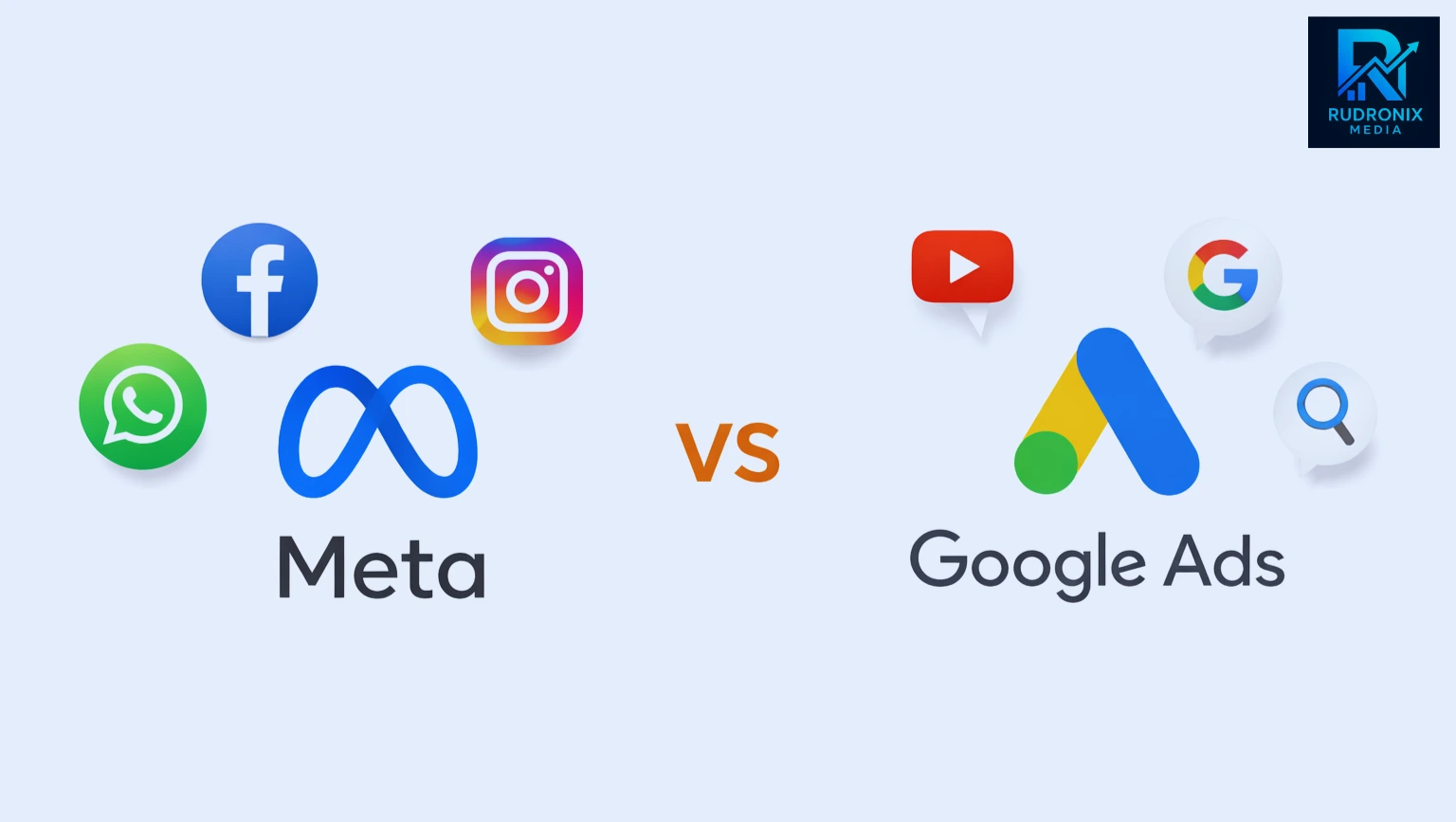
Google Ads captures active demand — people already searching for a solution
Meta Ads creates demand — it reaches people before they know they need you
Google is an intent machine; Meta is an awareness and discovery machine
The strongest campaigns use both platforms working together, not separately
The right split depends on your budget, market size, and business goals
Google Ads captures active demand — people already searching for a solution
Meta Ads creates demand — it reaches people before they know they need you
Google is an intent machine; Meta is an awareness and discovery machine
The strongest campaigns use both platforms working together, not separately
The right split depends on your budget, market size, and business goals
The Core Problem: You’re Paying for the Wrong Thing
Most businesses launch Google Ads expecting traffic. That’s the first misconception. Google has evolved into what advertising experts now call an intent machine; it no longer sells you clicks, it sells you the probability of conversion. The platform uses billions of behavioral data points to predict whether a searcher is likely to take action, then prices that moment accordingly.
That means a single click in a competitive industry can cost anywhere from $50 to over $1,000 and still not convert if your post-click experience is weak, your offer isn’t sharp, or your brand is unfamiliar to that searcher.
The real problem? Most businesses try to fix a brand awareness gap with a paid search budget — and wonder why costs keep climbing with diminishing returns.
Is your digital marketing built for where the market is going?
Spending on ads but not seeing results?
Rudronix Media audits your paid ad setup and shows you exactly where the budget is leaking.
Book your free consultation at rudronixmedia.com
Rudronix Media audits your paid ad setup and shows you exactly where the budget is leaking.
Book your free consultation at rudronixmedia.com
What Google Ads Actually Does Best
Google Ads is the most powerful tool for capturing in-market demand. When someone types “best digital marketing agency in Los Angeles” or “car insurance provider near me,” they already have a need. Google puts your offer in front of that person at the exact right moment.
But here is the catch: if your brand is invisible before that search happens, you’re competing against brands the searcher already recognizes. Brand familiarity heavily influences which result gets clicked, even on a paid results page. This is where Google alone falls short.
Google also rewards businesses that feed the algorithm quality data. Smart bidding strategies like Target CPA work far better than manual bidding when you connect your CRM and pass back signed conversions, not just form fills or calls as your endpoint event. The algorithm learns who converts and finds more of them.
What Meta Ads Actually Does Best
Meta, including Facebook and Instagram, operates on a completely different logic. Meta Ads don’t wait for someone to search. They use behavioral data from billions of users across Facebook, Instagram, and WhatsApp to predict who is likely to need your service, and then put your brand in their feed before they even start looking.
This makes Meta the superior platform for brand awareness, top-of-funnel reach, and demand creation. When a potential customer has seen your brand multiple times on Meta, they’re far more likely to click your Google ad when the moment of need finally arrives, instead of a competitor they’ve never heard of.
Meta’s Advantage AI (Andromeda) is now sophisticated enough to predict behavioral patterns and serve ads to users who are statistically likely to need a product or service in the near future. Combined with the right creative and a clear message, Meta can drive search behavior, not just respond to it.
The Winning Strategy: Meta Creates Demand, Google Captures It
The most effective campaigns we manage at Rudronix Media don’t treat these two platforms as separate channels competing for the same budget. We treat them as a two-stage funnel working in sequence.
Meta handles top-of-funnel awareness — getting your brand in front of the right audience before they have an active need. Then, when that need arises, a Google-branded or non-branded campaign captures that person right at the moment of intent. The result is lower cost-per-acquisition, stronger conversion rates, and a brand that compounds in value over time.
A smart starting point for most businesses: allocate 60–70% to Meta for awareness-building and 30–40% to Google for intent capture. Scale each channel based on what the data shows over the first 60–90 days.
One critical step: protect your brand on Google search from day one. If Meta is generating awareness and people search your name, competitors and lead resellers will bid on your brand name and steal that traffic. A branded search campaign is a non-negotiable part of the mix.
Quick Guide: When Should Your Business Use Each Platform?
Businesses often ask which platform deserves more budget. In reality, the answer depends on your growth stage and how customers discover your service.
Use Google Ads when:
- People are actively searching for your service
- You want high-intent leads quickly
- Your offer solves a clear problem that customers already know they have
Use Meta Ads when:
- Your brand is still building awareness
- You want to reach new audiences before they search
- Your product benefits from visual storytelling and repeated exposure
The most effective strategy combines both — building awareness on social platforms and capturing demand through search.
The AI Factor: Why Meta and Google Ads Still Influence AI Discovery
A third player is entering the advertising landscape: AI search. Tools like Google’s AI Overviews, ChatGPT, and Perplexity are increasingly answering questions like “best marketing agency near me” or “top PPC agency in Los Angeles” without sending users to a results page at all.
AI engines surface brands that have strong organic authority, consistent content, citations from trusted sources, and a recognizable brand name. This makes your Meta and Google strategy even more valuable: the awareness you build through paid ads feeds the brand recognition that AI tools use when determining which brands to recommend.
Stay Connected With Rudronix Media
We regularly share paid advertising insights, campaign learnings, and digital marketing updates across our social channels. Follow Rudronix Media here:
So, Who Is the King?
Neither platform wins alone. Google Ads without brand awareness is expensive and fragile. Meta Ads without search protection leaks lead to competitors. Together, with the right tracking, CRM integration, and creative strategy, they form the most powerful paid advertising system available to any business today.
The businesses seeing the best results right now aren’t asking which platform is better. They’re asking how to make both platforms work harder for each other, and that’s exactly the kind of strategy Rudronix Media builds.
Ready to build a smarter paid ads strategy?
At Rudronix Media, we help businesses in Los Angeles and beyond run Meta and Google Ads campaigns that work together, building brand authority, capturing high-intent leads, and turning ad spend into measurable revenue. Our team has managed campaigns across competitive markets with proven, data-backed results.
Book your free strategy consultation at info@rudronixmedia.com