Rudronix Media Google Ads Agency Los Angeles By the Rudronix Media Team | Updated March 2026 | Follow us on LinkedIn, Instagram, and Facebook The best landing page practices to increase conversions come down to one thing: removing every reason a visitor has to leave without taking action. For businesses in Los Angeles and across Southern California, where Google Ads costs are among the most competitive in the country, a poorly optimized landing page doesn’t just hurt conversions; it burns your entire ad budget. Driving traffic is only half the job. What happens after the click is where revenue is won or lost. This guide covers the exact practices that turn landing page visitors into leads in 2026. Why Most Landing Pages in Los Angeles Fail to Convert High ad spend and poor landing page performance are two of the most common problems Rudronix Media sees with California-based businesses. The traffic is there. The conversions aren’t. Most underperforming landing pages share the same problems: Cluttered layout with too many competing messages Weak or missing calls to action Slow load times, especially on mobile Messaging that doesn’t match the ad that sent the visitor there If your page confuses visitors, they leave, and they don’t come back. In a competitive LA market, that’s an expensive problem. Are your landing pages costing you leads? Get a free conversion audit from Rudronix Media and see exactly what’s holding your pages back. 7 Best Landing Page Practices to Increase Conversions in 2026 1. One Page, One Goal Every high-converting landing page focuses on a single action, a form submission, a phone call, or a booking. Multiple offers create decision fatigue and lower conversion rates. Strip the page down to one purpose and build everything around it. 2. Lead With a Headline That Earns Attention Your headline is the first thing visitors read. It needs to communicate what you offer, who it’s for, and why it matters, in one line. Weak: “Welcome to Our Services” Strong: “Get More Leads from Your Google Ads — Los Angeles PPC Management That Converts” Specificity wins, especially in local markets where users want to know you understand their context. 3. Match the Ad Message Exactly If a user in Pasadena clicks an ad for “affordable carpet cleaning,” your landing page must reflect those exact words and that exact promise. Any disconnect between the ad and the page creates distrust, and distrust kills conversions. This is called message match, and it’s one of the highest-leverage improvements any LA business can make immediately. 4. Make Your CTA Impossible to Miss Your call-to-action should be visible above the fold, repeated mid-page, and present again at the bottom. Use action-driven language tied to a real outcome: “Get a Free Quote for Your Los Angeles Project” “Book a Strategy Call Today” “Start Generating Leads This Week” Generic CTAs like “Submit” or “Click Here” consistently underperform against outcome-focused alternatives. 5. Load in Under Three Seconds Page speed directly impacts both conversion rate and Google Quality Score. For California businesses running Google Ads, a slow landing page raises your cost-per-click and lowers your ad position simultaneously. Compress all images, eliminate unused scripts, and use a fast hosting provider. Test your speed monthly using Google PageSpeed Insights. 6. Build Trust Before Asking for Anything Los Angeles consumers are sophisticated. They research before they act. Your landing page needs to reduce hesitation through: Verified Google reviews or star ratings Real client testimonials with names and locations Industry certifications or license numbers (especially for contractors and service businesses) A recognizable local address or service area map Trust signals directly preceding your CTA consistently lift conversion rates across service industries. 7. Design for Mobile First Over 60% of search traffic in California comes from mobile devices. If your landing page isn’t built for mobile — readable fonts, tap-friendly buttons, fast load on 5G, you’re losing the majority of your visitors before they even read your offer. Test every page on an iPhone and Android device before running any paid traffic to it. How Landing Pages Affect Your Google Ads Performance This connection is frequently underestimated. Google evaluates your landing page as part of your Quality Score, a metric that determines both your ad position and what you pay per click. A high-converting, well-structured landing page lowers your cost per lead in two ways: it improves Quality Score (reducing CPC), and it converts more of the traffic you’re already paying for. For Los Angeles businesses spending $1,500 or more per month on ads, this compound effect is significant. If your campaigns are already running but leads aren’t coming in, the fix may start before the landing page. Read our guide on Google Ads not generating leads for a full campaign audit. Not sure whether Google or Meta is the right paid channel for your business? Check out our breakdown of Meta Ads vs Google Ads before scaling your budget. Landing Page Optimization Checklist for 2026 Use this before launching any campaign: Single, focused conversion goal Headline communicates value in one line Ad message matches the landing page message exactly CTA is visible above the fold and repeated Page loads in under three seconds Mobile experience is fully optimized Trust signals appear before the CTA No navigation links are pulling visitors off the page The form asks for minimal information only Every “no” on this list is a conversion you’re currently not getting. FAQs: Landing Page Conversion Optimization What is the most important element of a high-converting landing page? Message match, the alignment between your ad, your headline, and your offer, has the single biggest impact on conversion rate. When visitors immediately recognize that the page delivers what the ad promised, trust is established instantly. How many CTAs should a landing page have? Three placements are the standard for most service pages: above the fold, mid-page, and at the bottom. All three should use the same action-oriented language tied to a specific outcome. How does page speed affect conversions for Los
How to Appear in Google AI Overviews in 2026 (A Small Business Guide)
Rudronix Media Google Ads Agency Los Angeles By the Rudronix Media Team | Updated March 2026 | Follow us on LinkedIn, Instagram, and Facebook If you want to appear in Google AI Overviews in 2026, your content strategy needs to change and fast. Google’s AI-generated summaries are now answering user questions directly on the search results page, often before a single website gets clicked. For small businesses, this is both a threat and a significant opportunity. If your content gets pulled into these AI answers, you gain visibility and authority without users even needing to search further. If it doesn’t, your organic traffic quietly disappears even when your rankings look fine. Here’s exactly what you need to do. What Are Google AI Overviews? Google AI Overviews are AI-generated answer boxes that appear at the top of search results. They pull information from multiple websites and deliver a summarized, direct answer to a user’s query, covering everything from quick definitions and product comparisons to step-by-step solutions. Traditional SEO alone won’t get you featured here. But Google still sources these answers from real websites. That means if your content is structured correctly, your business can be one of those cited sources. Why This Matters for Small Businesses Many small businesses across the US are already noticing the impact: lower click-through rates, fewer website visits, and declining organic leads — even with stable rankings. The businesses winning in this environment aren’t necessarily the biggest. They’re the ones producing clear, structured, intent-matched content that AI can easily read and extract. That’s a playing field small businesses can compete on. Is your content ready for AI search? Contact Rudronix Media for a free AI SEO content audit and find out where you stand. 5 Strategies to Appear in Google AI Overviews 1. Lead With Direct Answers AI Overviews prioritize content that answers the question immediately, not after three paragraphs of introduction. Every section of your content should open with a concise, direct response before expanding into detail. Instead of: “Google Ads are an important tool for businesses…” Write: “If your Google Ads are not generating leads, the cause is usually poor targeting or a weak landing page.” is exactly what AI extracts. See our full guide on Google Ads not generating leads for context. This answer-first structure is what AI is built to detect and reward. 2. Build Structured FAQ Sections FAQs are one of the most reliable ways to get featured in AI Overviews. They map directly to how users phrase questions in search, and they give AI clear, extractable Q&A pairs. For a small business blog, relevant FAQ entries might include: What are Google AI Overviews? How do small businesses appear in AI search results? What is Generative Engine Optimization (GEO)? Include at least three to five FAQs per article and place them toward the end of the post. 3. Implement Schema Markup Structured data tells search engines exactly what your content means — and it significantly improves your chances of being cited in AI results. The most important schema types for small business content are the FAQ schema, the Article schema, and the LocalBusiness schema. If you’re a service business in Los Angeles, California, or Pennsylvania, the LocalBusiness schema also reinforces your geographic relevance in local AI queries. 4. Build Trust Through Real Experience Google’s AI Overviews prioritize content that demonstrates genuine expertise and real-world experience, known as E-E-A-T (Experience, Expertise, Authoritativeness, Trustworthiness). Strengthen your content by adding case study results, client outcomes, specific before-and-after data, and first-person insights from work you’ve actually done. Generic content written without real-world grounding gets filtered out. Specific, experience-backed content gets cited. Our guide on best landing page practices to increase conversions is a good reference. 5. Target Specific, Narrow Topics Broad topics like “digital marketing tips” are difficult for AI to extract clean answers from. Narrow, specific topics like “how to improve Google Ads conversion rate for a local service business” give AI exactly what it needs. One focused topic per article, covered thoroughly, outperforms an article that tries to cover five things shallowly. Common Mistakes That Keep You Out of AI Overviews Writing generic content with no direct answers Ignoring FAQ sections and schema markup Covering topics too broadly Relying only on traditional keyword SEO without considering AI readability Missing EEAT signals, like author credentials or real client examples How AI Overviews Fit Into Your Overall SEO Strategy AI search is not replacing SEO — it’s evolving it. The businesses that stay visible in 2026 will be the ones combining traditional on-page SEO with structured, intent-driven content built for both human readers and AI systems. This approach is increasingly called Generative Engine Optimization (GEO), and it’s becoming as important as keyword rankings. Appearing in Google AI Overviews in 2026 is achievable for small businesses — but it requires a smarter content approach. Focus on direct answers, structured formatting, real-world experience signals, and schema markup. These aren’t trends. They’re the new baseline for organic visibility. Ready to optimize your content for AI search? Rudronix Media works with small businesses across the US to build content strategies that get featured. Book your free strategy session today. FAQs: Google AI Overviews for Small Businesses What content gets featured in Google AI Overviews? Content that directly answers user questions, uses structured formatting, and includes schema markup has the highest chance of being cited. Do I need technical SEO to appear in AI Overviews? Yes. Schema markup and proper site structure are important signals that help AI identify and trust your content. How long does it take to appear in AI Overviews? There’s no fixed timeline, but consistently publishing structured, high-quality content typically produces results within 60 to 90 days.
Google Ads Not Generating Leads? Here’s How to Fix It
Rudronix Media Google Ads Agency Los Angeles By the Rudronix Media Team | Updated March 2026 | Follow us on LinkedIn, Instagram, and Facebook If your Google Ads are not generating leads, you are not alone. Businesses across Los Angeles and California spend hundreds, sometimes thousands, per month on paid search, only to see clicks pile up with zero conversions to show for it. The problem is rarely Google Ads itself. It’s almost always the case with how the campaign is set up, targeted, and managed. The good news is that most of these issues are fixable once you know where to look. This guide breaks down the exact reasons your campaigns aren’t converting, and what to do about each one. Why Clicks Don’t Always Turn Into Leads Clicks without conversions typically point to one of two problems: you’re attracting the wrong audience, or your landing page isn’t persuading visitors to act. Google Ads performs best when your targeting, ad messaging, and landing page all align. When even one element is off, your conversion rate drops and your budget gets wasted. Running Google Ads in Los Angeles or California and not seeing leads? Request a free campaign audit from Rudronix Media today. 7 Reasons Your Google Ads Are Not Generating Leads 1. Wrong Keywords Broad, low-intent keywords like “marketing agency” attract browsers, not buyers. High-intent phrases like “Google Ads agency in Los Angeles” or “PPC management California” target people ready to act. Fix: Build your keyword list around terms that signal purchase or contact intent. 2. Poor Audience Targeting Even with strong keywords, showing ads to the wrong location wastes the budget fast. California-based businesses need geo-targeting dialed in; audiences in Los Angeles, San Diego, and Sacramento behave differently. Fix: Narrow your audience by city, ZIP code, and device type to match your ideal customer. 3. Weak Ad Copy If your ad doesn’t communicate a clear benefit and a strong call to action, users won’t convert. Fix: Use outcome-focused language. “Get a Free Quote Today” or “Speak to a Los Angeles PPC Expert Now” outperforms generic messaging every time. 4. Landing Page Problems This is the number one cause of low lead volume. A landing page that loads slowly, looks untrustworthy, or doesn’t match your ad will lose visitors within seconds. A poorly optimized page is one of the biggest conversion killers. Learn exactly what fixes to make in our guide on best landing page practices to increase conversions. Fix: Your landing page should load in under three seconds, mirror the ad message, and have a single, clear conversion goal, either a form, a call button, or a booking link. 5. No Conversion Tracking Without proper tracking, you can’t tell which keywords or ads are actually bringing in leads. You end up optimizing blindly. Fix: Set up Google Tag Manager to track form submissions, phone calls, and button clicks. This data drives every smart decision you’ll make. 6. Budget Spread Too Thin Splitting a small budget across five campaigns at $10/day each gives none of them enough data to perform. This is a common mistake in competitive California markets. Fix: Consolidate into one or two focused campaigns and run them long enough to gather reliable performance data. 7. No Ongoing Optimization Google Ads is not set-it-and-forget-it. Without regular adjustments, campaigns drift, wasting spend on irrelevant searches. Fix: Review search term reports, negative keywords, and bid strategy weekly. Quick Campaign Audit Checklist Use this to find the leak in your campaign: Are your keywords high-intent and location-specific? Does your ad copy include a clear call to action? Does your landing page match the ad and load in under 3 seconds? Is conversion tracking installed and firing correctly? Is your budget focused solely on top-performing campaigns? A “no” anywhere here is where your leads are going. Not sure whether Google Ads is even the right channel for your business? Read our breakdown of Meta Ads vs Google Ads to understand which platform drives better results for your goals. How to Improve Your Google Ads Conversion Rate Three things consistently move the needle beyond the fixes above: Add trust signals. Testimonials, Google reviews, and client results, especially from California businesses, build credibility and increase form completions. Test ad variations. Run two to three ad versions at once. Small headline changes can produce meaningful lifts in click-through and conversion rates. Use dedicated landing pages. Don’t send all traffic to your homepage. Build separate pages for each service and location you’re targeting. When to Bring In a Google Ads Expert If you’ve implemented these fixes and are still not generating leads, it’s time to seek professional help. Profitable paid search requires ongoing testing, data analysis, and strategic adjustments that take time to master. Stop wasting your Google Ads budget. Contact Rudronix Media for expert PPC management in Los Angeles and across California, and book your free strategy session today. Google Ads not generating leads is a solvable problem, but throwing more budget at a broken campaign won’t fix it. Start with the fundamentals: targeting, copy, landing page, and tracking. Get those right, and your campaigns will start performing the way they should.
SEO in 2026: Vocabulary, Trends, GEO vs AIO vs AEO and Your Cheat Sheet
By the Rudronix Media Team | Updated March 2026 Follow us on LinkedIn, Instagram, and Facebook for weekly digital marketing insights. SEO in 2026 is not what it was three years ago. Google, AI tools, and voice assistants have all changed how people find businesses — and the brands keeping up are the ones that understand what SEO actually means today, not what it meant in 2023. This guide covers the vocabulary, the four disciplines of modern search visibility, the trends shaping 2026, and a practical cheat sheet your team can use right now. What is SEO in 2026? SEO = making your content discoverable across search engines and AI platforms Modern SEO includes four disciplines: SEO, GEO, AIO, and AEO The goal is no longer just page one — it’s being cited and recommended everywhere Technical health, content authority, and digital PR all work together The SEO Vocabulary You Actually Need Here are the terms that come up in every SEO conversation — explained plainly: Term What It Means Keyword The word or phrase a user types into the search. Your content must target these to appear in relevant results. SERP Search Engine Results Page — the page shown after a search query. Ranking here is the primary SEO goal. On-Page SEO Optimisation done on your actual pages — titles, headings, content, keywords, and internal links. Off-Page SEO Actions outside your site that build authority — primarily earning backlinks from reputable websites. Technical SEO Site speed, mobile-friendliness, Core Web Vitals, schema markup, and crawlability. E-E-A-T Experience, Expertise, Authoritativeness, Trustworthiness — Google’s content quality framework. Schema Markup Structured code that tells search engines exactly what your content is about — enables rich results. Zero-Click A search answered directly on the results page — no click required. Featured Snippets and AI Overviews trigger these. The Problem: Most Businesses Are Running 2020 SEO in 2026 Stuffing keywords and building a few links used to work. Today, organic listings are buried beneath Local Service Ads, Google Maps packs, AI Overviews, and sponsored results. AI tools like ChatGPT and Perplexity answer questions before any website gets a click. If your SEO strategy has not evolved, you are not just ranking lower; you are functionally invisible to a large portion of your audience. Is your business invisible on Google? Rudronix Media’s SEO audits show exactly where your visibility is breaking down — and how to fix it. Book your free consultation at info@rudronixmedia.com SEO vs GEO vs AIO vs AEO — What’s the Difference? Search visibility now spans four disciplines. Here is how they differ: Type Platform User Behaviour Win With SEO Google, Bing Types keyword, clicks result Keyword relevance + authority GEO AI Overviews, Perplexity Searches, reads AI summary Structured, citable content AIO ChatGPT, Gemini, Claude Asks AI for a recommendation Multi-source brand citations via digital PR AEO Voice search, Snippets Asks a full question, wants a direct answer Concise Q&A content + FAQ schema 5 SEO Trends Shaping 2026 Zero-click is the default. 26%+ of searches end without a click. Your content must be the source AI Overviews and Snippets cite — not just the page they skip. E-E-A-T is non-negotiable. Generic AI content scores poorly. Real expertise, author credentials, case studies, and original data are what Google’s quality systems reward now. Digital PR is the new link building. Editorial mentions in authoritative publications build the kind of trust that Google and AI engines act on. Self-published rankings and directory links no longer move the needle the way they once did. Topical authority beats individual keywords. Publishing a cluster of related content around one subject signals domain expertise. One perfect page cannot compete with ten well-linked, in-depth pieces on the same topic. Local SEO and AI search now overlap. A complete Google Business Profile with reviews and regular posts now influences both Local Pack rankings and what AI tools recommend when someone searches ‘near me.’ The 2026 SEO Cheat Sheet Technical Page speed under 2.5s · HTTPS · Mobile-first · No broken links Schema markup on every key page (FAQ, Article, LocalBusiness) XML sitemap in Google Search Console · Core Web Vitals in ‘Good’ range On-Page Unique title tag (under 60 chars) · Meta description (under 155 chars) One H1 with primary keyword · Keyword in first 100 words 2+ internal links per page · Image alt text on every image Content + GEO / AIO / AEO Publish in topic clusters, not isolated posts · Add author bios with credentials Include FAQ sections targeting People Also Ask questions Earn third-party citations through digital PR — do not just self-publish Monitor brand mentions in ChatGPT, Perplexity, and Google AI Overviews monthly The brands winning on Google and AI right now share one thing: other trusted sources are talking about them. Digital PR, earning editorial mentions, interviews, and citations in industry publications, is the highest-leverage SEO activity in 2026. Your own website can only take you so far. External authority is what makes the difference. For a deeper look at how paid and organic work together, read our guide on Meta Ads vs Google Ads: Who Is the Real King of Digital Advertising? Ready to build an SEO strategy that works in 2026? Rudronix Media builds full-stack SEO strategies for businesses in Los Angeles and beyond — technical SEO, content authority, local search, and digital PR that compounds over time. Get your free SEO audit and see exactly where your visibility stands. Book your free SEO audit at info@rudronixmedia.com
Meta Ads vs Google Ads: Who Is the Real King of Digital Advertising?
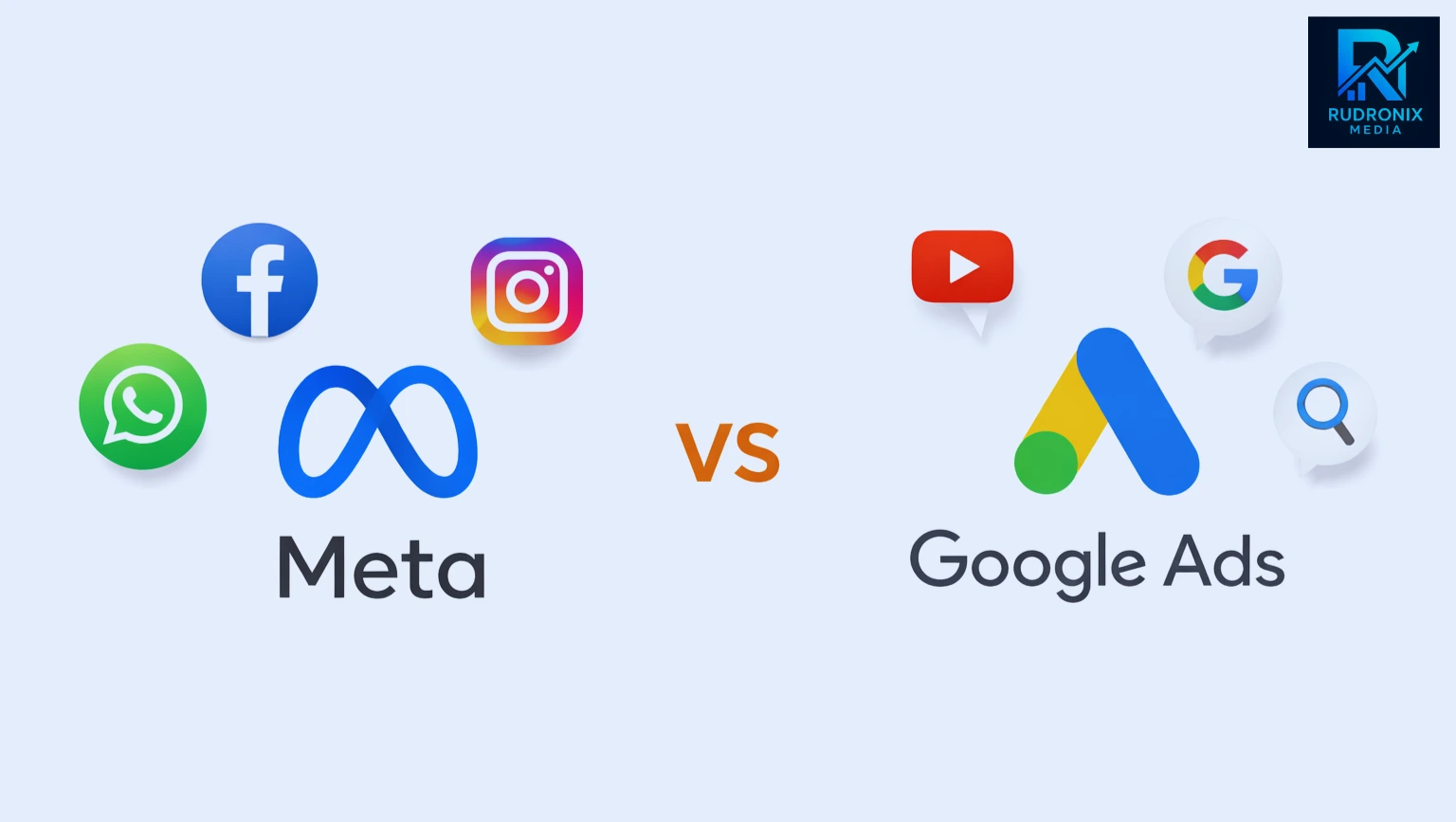
By the Rudronix Media Team | Updated March 2026 Follow us on LinkedIn, Instagram, and Facebook for weekly digital marketing insights. Every business owner eventually faces the same question: Should I spend my ad budget on Google or Meta? It sounds simple. But the honest answer is, after managing millions in ad spend across both platforms, picking just one is the wrong move entirely. At Rudronix Media, we have run campaigns on both platforms for businesses ranging from local service providers to growing brands in Los Angeles and beyond. And the patterns are clear. Each platform has a specific role to play, and when both work together, the results compound dramatically. Meta Ads vs Google Ads — What’s the Difference? Google Ads captures active demand — people already searching for a solution Meta Ads creates demand — it reaches people before they know they need you Google is an intent machine; Meta is an awareness and discovery machine The strongest campaigns use both platforms working together, not separately The right split depends on your budget, market size, and business goals The Core Problem: You’re Paying for the Wrong Thing Most businesses launch Google Ads expecting traffic. That’s the first misconception. Google has evolved into what advertising experts now call an intent machine; it no longer sells you clicks, it sells you the probability of conversion. The platform uses billions of behavioral data points to predict whether a searcher is likely to take action, then prices that moment accordingly. That means a single click in a competitive industry can cost anywhere from $50 to over $1,000 and still not convert if your post-click experience is weak, your offer isn’t sharp, or your brand is unfamiliar to that searcher. The real problem? Most businesses try to fix a brand awareness gap with a paid search budget — and wonder why costs keep climbing with diminishing returns. Is your digital marketing built for where the market is going? Spending on ads but not seeing results? Rudronix Media audits your paid ad setup and shows you exactly where the budget is leaking. Book your free consultation at rudronixmedia.com What Google Ads Actually Does Best Google Ads is the most powerful tool for capturing in-market demand. When someone types “best digital marketing agency in Los Angeles” or “car insurance provider near me,” they already have a need. Google puts your offer in front of that person at the exact right moment. But here is the catch: if your brand is invisible before that search happens, you’re competing against brands the searcher already recognizes. Brand familiarity heavily influences which result gets clicked, even on a paid results page. This is where Google alone falls short. Google also rewards businesses that feed the algorithm quality data. Smart bidding strategies like Target CPA work far better than manual bidding when you connect your CRM and pass back signed conversions, not just form fills or calls as your endpoint event. The algorithm learns who converts and finds more of them. What Meta Ads Actually Does Best Meta, including Facebook and Instagram, operates on a completely different logic. Meta Ads don’t wait for someone to search. They use behavioral data from billions of users across Facebook, Instagram, and WhatsApp to predict who is likely to need your service, and then put your brand in their feed before they even start looking. This makes Meta the superior platform for brand awareness, top-of-funnel reach, and demand creation. When a potential customer has seen your brand multiple times on Meta, they’re far more likely to click your Google ad when the moment of need finally arrives, instead of a competitor they’ve never heard of. Meta’s Advantage AI (Andromeda) is now sophisticated enough to predict behavioral patterns and serve ads to users who are statistically likely to need a product or service in the near future. Combined with the right creative and a clear message, Meta can drive search behavior, not just respond to it. The Winning Strategy: Meta Creates Demand, Google Captures It The most effective campaigns we manage at Rudronix Media don’t treat these two platforms as separate channels competing for the same budget. We treat them as a two-stage funnel working in sequence. Meta handles top-of-funnel awareness — getting your brand in front of the right audience before they have an active need. Then, when that need arises, a Google-branded or non-branded campaign captures that person right at the moment of intent. The result is lower cost-per-acquisition, stronger conversion rates, and a brand that compounds in value over time. A smart starting point for most businesses: allocate 60–70% to Meta for awareness-building and 30–40% to Google for intent capture. Scale each channel based on what the data shows over the first 60–90 days. One critical step: protect your brand on Google search from day one. If Meta is generating awareness and people search your name, competitors and lead resellers will bid on your brand name and steal that traffic. A branded search campaign is a non-negotiable part of the mix. Quick Guide: When Should Your Business Use Each Platform? Businesses often ask which platform deserves more budget. In reality, the answer depends on your growth stage and how customers discover your service. Use Google Ads when: People are actively searching for your service You want high-intent leads quickly Your offer solves a clear problem that customers already know they have Use Meta Ads when: Your brand is still building awareness You want to reach new audiences before they search Your product benefits from visual storytelling and repeated exposure The most effective strategy combines both — building awareness on social platforms and capturing demand through search. The AI Factor: Why Meta and Google Ads Still Influence AI Discovery A third player is entering the advertising landscape: AI search. Tools like Google’s AI Overviews, ChatGPT, and Perplexity are increasingly answering questions like “best marketing agency near me” or “top PPC agency in Los Angeles” without sending users to a results page at
8 Digital Marketing Trends Every Business Must Act On in 2026
The way customers find businesses has shifted quietly but completely. At Rudronix Media, we manage campaigns across industries every day, and what we are seeing in 2026 is too significant to ignore. These are the shifts we are actively responding to on behalf of the brands we work with. At Rudronix Media, we specialize in helping ambitious brands unlock next-level growth through digital marketing. Here are five key marketing strategies you should implement to scale successfully in 2025. What are the most important digital marketing trends in 2026? Keep leads on the platform — social algorithms punish off-platform redirects Optimise for every search surface, not just Google Use AI as a thinking tool, not a publishing machine Earn citations so AI engines recommend your brand by default Prepare for intent-based ad targeting that blends Meta and Google logic Make your website readable for AI-powered browsers, not just human visitors Go live — authenticity is the scarcest asset online right now Distribute content in multiple languages to unlock global audiences Trend 1. Your Social Audience Does Not Want to Leave the App Every major platform — Instagram, LinkedIn, Facebook — suppresses content that pushes users away. We see it consistently with clients: drop a link in the caption and reach shrinks. The fix is building lead capture inside the platform, automated DMs, native lead forms, and in-app flows. Result: higher quality leads from people who chose to engage, not cold landing page arrivals. Trend 2. Search Is Happening in Places Google Cannot See When clients ask why their Google traffic plateaued, the answer is usually the same: their customers moved somewhere else. Instagram, YouTube, TikTok, ChatGPT, Gemini, and Perplexity are all search surfaces now. Winning visibility in 2026 means every piece of content — video scripts, captions, descriptions — carries consistent keyword signals across all of them. Trend 3. AI Output Is Only as Good as the Human Behind It The brands getting hurt by AI are publishing raw output without review, and it shows. Generic content erodes trust with readers and with Google’s quality signals. The brands winning are using AI to go faster — drafting structures, stress-testing angles while a real expert shapes the final message. Our view: AI multiplies capable marketers. Use it to accelerate, not replace judgment. Is your content strategy built for 2026? Rudronix Media builds content and SEO systems that combine human expertise with smart AI — so your brand ranks and converts. Book a free consultation at rudronixmedia.com Trend 4. AI Tools Are Learning Whose Name to Say — Make Sure It Is Yours When someone asks ChatGPT or Perplexity for a recommendation, those tools surface brands cited across authoritative sources, not the brands with the most keywords. This is reputation architecture. The brands getting recommended today earned editorial mentions and had other trusted voices speak about them before it became obvious. Trend 5. The Next Wave of Ad Targeting Will Know More Than Your Search History AI-powered advertising will not work like Google Ads. It will draw from behavioural patterns, conversation history, and interest signals, meaning brand category association will matter more than keyword bids. The brands with consistent, specific content built around a defined audience will be the natural recommendations these systems surface. Trend 6. Your Website Now Has Two Audiences — Humans and AI Agents AI is moving into the browser layer — Chrome with Gemini, ChatGPT’s browsing tools, Perplexity’s Comet. These agents summarise and recommend before users land anywhere. Your website needs clean headings, schema markup, and current content so AI can extract and cite it. Quick check: does every key page have a clear H1, FAQ schema, and updated information? Trend 7. The Most Trusted Content in 2026 Cannot Be Generated Every platform is flooded with polished, AI-assisted content. Live video — unscripted and real — is what audiences trust more. YouTube’s own data shows nearly a third of users watch at least one live every week, yet most brands never go live. One session produces clips, shorts, and repurposed moments automatically. The shift: show up consistently and imperfectly. Authenticity converts better than polish. Trend 8. The Language Barrier Just Disappeared — Most Brands Have Not Noticed Auto-dubbing tools now recreate your voice in dozens of languages accurately enough that audiences engage as native content. Creators who enabled this early are seeing 30–50% of views from markets they never targeted. For businesses in competitive local markets like Los Angeles, a Spanish-language version of your best content does not need a translator — it needs a setting toggled on. Every trend here rewards the same thing: brands that build genuine authority through consistent content, earned citations, and sound digital infrastructure compound in visibility over time. For a deeper look at how paid advertising fits alongside these strategies, read our guide on Meta Ads vs Google Ads: Who Is the Real King of Digital Advertising? Stay Connected With Rudronix Media Digital marketing trends evolve quickly, and we regularly share insights, campaign learnings, and platform updates on our social channels. Follow Rudronix Media here: • Instagram • Facebook • LinkedIn Is your digital marketing built for where the market is going? Rudronix Media works with businesses in Los Angeles and beyond — building visibility strategies across SEO, paid ads, content, and social. We track what is actually shifting on each platform and translate it into clear, actionable steps for the brands we work with. Book your free strategy consultation at rudronixmedia.com
Is Your Google Business Profile Costing You Leads? Fix It with Local SEO in Los Angeles
Introduction If you’re a small business owner in Los Angeles, your Google Business Profile (GBP) could be your most valuable (or most overlooked) digital asset. A properly optimized GBP helps your business appear in local search results, Google Maps, and “near me” searches — exactly where your customers are looking. But if your profile is incomplete or mismanaged, you could be losing out on leads every single day. “At Rudronix Media, we specialize in turning Google Business Profiles into lead-generation engines for service-based and local businesses across LA. ” Data doesn’t lie. It leads. Innovative Marketing Tactics for Modern Businesses Why a Fully Optimized Google Business Profile Matters: A well-maintained GBP can: ✅ Rank you in the top 3 spots of local Google results ✅ Drive phone calls, website clicks, and direction requests ✅ Build trust with consistent reviews and service updates ✅ Help you appear for “near me” and geo-targeted keywords ✅ Improve your online reputation with real-time Common Google Business Profile Issues Hurting Your Visibility: We regularly help LA businesses overcome issues like: ❌ Incomplete or outdated business listings ❌ Suspended profiles with no clear reason ❌ Weak local SEO and missing keywords ❌ Unmanaged negative reviews ❌ Low-quality or missing images ❌ No regular posting or engagement What Rudronix Media Offers Los Angeles Businesses: As a local marketing agency, we provide: ✅ GBP setup, claim, and verification ✅ Keyword-rich business descriptions ✅ Review generation and reputation management ✅ Consistent photo uploads and weekly updates ✅ Local SEO strategy tailored to Los Angeles zip codes ✅ Performance tracking and monthly reports 📈 At Rudronix Media, our clients see higher conversions by optimizing their Google Business Profile with data-driven strategies. Why Los Angeles Businesses Trust Rudronix Media? We understand LA’s competitive digital landscape — whether you’re a contractor in West LA, a cleaning service in Pasadena, or a salon in Santa Monica, we customize your Google Business Profile for maximum exposure and conversion. 🔍 We use tools like Google Business Profile Insights, Google Analytics 4, and local SEO tracking to monitor performance across the entire local search funnel. 📞 Ready to unlock more calls, leads, and walk-ins? 👉 Let’s optimize your GBP today.Book a free consultation at www.rudronixmedia.com
5 Mistakes That Are Holding Your Business Back (And How to Fix Them)
Introduction Running a business is tough—especially in a competitive market like Los Angeles. While passion and hard work go a long way, even the most dedicated entrepreneurs can hit a wall due to overlooked errors. At Rudronix Media, we’ve helped countless small businesses and startups identify blind spots and unlock sustainable growth. In this blog, we’ll cover 5 common mistakes that may be holding your business back—and more importantly, how to fix them. “Success in business doesn’t come from doing everything right—it comes from avoiding the big mistakes and adapting fast.” 1. Ignoring Your Digital Presence In 2025, if you’re not visible online, you’re invisible to your customers. Many businesses still rely heavily on word-of-mouth or outdated websites. Fix It: Invest in a responsive, SEO-optimized website Claim and optimize your Google Business Profile Build an active presence on social media where your audience lives 💡 Need help? Rudronix Media specializes in digital makeovers for LA businesses. 2. No Clear Marketing Strategy Random posts and occasional ads don’t count as a marketing strategy. If you’re not planning, tracking, and optimizing, you’re wasting money. Fix It: Define clear goals: traffic, leads, sales, brand awareness Build an integrated strategy: SEO + PPC + Social Media + Email Use analytics tools to measure results and adjust monthly ✅ Rudronix Media offers tailored digital marketing strategies backed by real data. 3. Targeting the Wrong Audience You might have a great product or service, but if you’re speaking to the wrong people, it won’t convert. Fix It: Create detailed buyer personas based on location, interests, and behaviors Use Google Ads & Meta Ads to laser-target the right demographics Segment your email and retargeting campaigns 🎯 Knowing your audience = better ROI. 4. Underestimating the Power of Local SEO If you’re a Los Angeles-based business, you should be showing up in local search results. Without proper local SEO, you miss valuable nearby customers. Fix It: Add local keywords (e.g., “digital agency in Los Angeles”) to your site Get listed on local directories (Yelp, Bing, Apple Maps) Encourage satisfied clients to leave Google reviews 📍 Rudronix Media helps LA businesses rank higher locally and attract foot traffic and calls. 5. Doing It All Yourself You’re the CEO, not a full-time marketer, web designer, and strategist. Trying to juggle everything often results in burnout—and missed opportunities. Fix It: Outsource to trusted professionals for marketing, design, and SEO Focus your energy on scaling, innovating, and managing relationships Partner with an agency like Rudronix Media that acts as your growth partner 🙌 You don’t have to do it alone. That’s why we’re here. Innovative Marketing Tactics for Modern Businesses If any of the issues above sound familiar, it’s time to make a change. At Rudronix Media, we help businesses in Los Angeles and beyond build powerful digital strategies that deliver real results. Whether you need a full marketing overhaul or just a push in the right direction, we’ve got your back. 📞 Ready to Break Through What’s Holding You Back? Let’s talk! Book a free consultation with Rudronix Media and discover how we can take your business to the next level.
How to Create a Business Plan That Drives Results
Creating a business plan isn’t just a formality—it’s a roadmap to success. Whether you’re launching a startup in Los Angeles or expanding your current venture, a well-crafted business plan sets the foundation for growth, direction, and measurable results. At Rudronix Media, we work with LA-based businesses daily, helping them not just build plans, but execute winning strategies. In this post, we’ll guide you through creating a business plan that delivers real-world results in today’s competitive landscape. “Creating a business plan that drives results in Los Angeles takes more than templates. It requires local insight, strategic thinking, and data-backed decisions. Whether you’re a new entrepreneur or an established business ready to scale, Rudronix Media is here to help you turn that plan into action..” Every successful business begins with clarity. Define what your business stands for and what you aim to achieve. Vision Statement: Where do you see your business in 3–5 years? Mission Statement: What problem do you solve, and how? Example (Los Angeles-based): “To be LA’s most trusted eco-friendly cleaning service, delivering spotless results with sustainable practices.” Innovative Marketing Tactics for Modern Businesses Ready to Grow Your Business in LA? Contact Rudronix Media today for a free strategy session and see how our digital solutions can support your business goals in Los Angeles. Start With a Clear Vision and Mission Analyze Your Market (Especially in Los Angeles) Define Your Target Audience Set SMART Goals Outline Your Digital Marketing Strategy Financial Planning and Forecasts Execution Plan: Who, What, When Review, Test, and Optimize
Unlocking the Power of Data-Driven Decisions: Why Smart Marketing Starts with Insight
Introduction In a digital-first world, guesswork is no longer enough. Every click, impression, and scroll tells a story—and smart businesses are listening. At Rudronix Media, we believe that data-driven decisions are the key to consistent growth and scalable success. Whether you’re a startup in Los Angeles or an established brand looking to optimize ROI, understanding your data is what turns average campaigns into exceptional ones. Here’s how unlocking data can reshape your marketing strategy. “A recent Rudronix Media client saw a 37% increase in lead conversions after we overhauled their Google Ads strategy based on data insights. By reallocating budget and targeting high-performing keywords, we reduced CPC by 42%—all in just 60 days.” Data doesn’t lie. It leads. 1. What Does “Data-Driven” Really Mean? A data-driven approach means using facts, figures, and analytics—not assumptions—to guide decisions. From choosing the right audience to optimizing ad spend, it’s about being strategic, not just reactive. Why It Matters: Eliminates guesswork and emotional bias Pinpoints what’s working and what isn’t Improves marketing efficiency and ROI 2. The Benefits of Data-Driven Marketing When you tap into data, you gain control and clarity over your strategy. This leads to faster growth and smarter scaling. Key Benefits: Audience insights: Understand behavior, preferences, and buying patterns Performance tracking: Know which channels convert best Budget optimization: Stop wasting ad spend on underperforming efforts Real-time improvements: Make quick, confident campaign changes 📈 At Rudronix Media, our clients see higher conversions with data-backed campaigns. 3. What Kind of Data Should You Be Tracking? You don’t need to track everything—just the right things. Here’s where to start: Core Marketing Metrics: Traffic Sources (Google, Meta, referrals, direct) Cost Per Click (CPC) and Cost Per Lead (CPL) Conversion Rate and Return on Ad Spend (ROAS) Engagement Metrics (bounce rate, time on site, pages per visit) Customer Lifetime Value (CLV) 🔍 We use tools like Google Analytics 4, Meta Ads Manager, and Hotjar to track the full funnel. 4. Tools That Power Data-Driven Decisions To be effective, you need the right tools and dashboards that give you a 360° view of your marketing performance. Recommended Tools: Google Analytics 4 (GA4) – Behavior & conversion tracking Google Looker Studio – Custom dashboards & visual reports Meta Ads Manager – Social campaign performance Hotjar / Crazy Egg – Heatmaps & user behavior HubSpot / Klaviyo – Email engagement & automation insights 🔗 Rudronix Media builds custom dashboards for clients to track and grow with confidence. 5. Turning Insights into Action Collecting data is only part of the puzzle—the real power lies in applying it. Here’s how we help brands transform numbers into strategies: Split-test creatives, offers, and audiences Adjust budget allocation based on performance data Retarget users who didn’t convert the first time Personalize messaging based on customer behavior 💡 Our data-driven approach means every decision supports business goals, not vanity metrics. Innovative Marketing Tactics for Modern Businesses Marketing without data is like sailing without a compass. If you’re looking to scale your business, dominate your market, or simply stop wasting your budget—it starts with a data-driven mindset. At Rudronix Media, we specialize in building strategies that are fueled by data and designed for growth. Our team of analysts, marketers, and strategists is ready to help you unlock the full potential of your digital presence. 📞 Ready to Make Smarter Decisions? Let Rudronix Media show you the power of performance-driven strategy. Book a free consultation today and take the first step toward data-backed success.